Cell mechanics
What role do cell shape and mechanical interactions play as crypts form?
Physics · Syracuse University
Physics · Syracuse University
In Treatise of Man (1633), Discourse on the Method (1637), and Meditations (1641), René Descartes separated mind from body and laid out the bête-machine (“animal-machine”) doctrine: all non-human organisms and all biological bodies are mechanical automata, incapable of genuine learning, cognition, or agency without a rational mind directing them; even a trained animal was, for him, only a rearranged machine. Modern biology dropped the Cartesian soul but kept much of its top-down control architecture, handing the mind’s role to the central nervous system or to the genome and its “master regulator” genes, and treating the body and its material environment as passive hardware executing instructions (Nicholson 2014).
Yet across scales, matter routinely violates this hierarchy. Bacteria coordinate collective decisions through chemical quorum sensing, without a leader (Miller & Bassler 2001); developing tissues pattern through cell–matrix mechanochemical feedback (Mammoto & Ingber 2010); and disordered solids encode memories of past deformations in their own degrees of freedom (Keim et al. 2019).
Physics treats learning as a problem any adaptive material faces, constrained by how energy flows through it, how it is built, and how forces act within it. My doctoral work starts from this bottom-up view and asks how much matter can achieve through local mechanics, without a central controller. In the bacterium E. coli, I trained a model of the disordered cell wall to steer the cell away from surfaces, with no brain. In spring networks, I study why continual learning exhausts the capacity to learn, why restoring it calls for an offline, sleep-like phase, and whether sleep–wake rhythms can emerge spontaneously. In intestinal organoids, I am beginning to model how crypts form, with S. Ameen’s model of a spheroid in a fiber-network matrix, built on T. Zhang’s 3D vertex model code (Zhang & Schwarz 2022; Zhang et al. 2025; Ameen et al. 2026).
The ideas are clearer when you can try them, not only read about them.
Or follow the glowing line to the latest project.
Loading the spring…
Loading physical learning…
Loading Sleep in spring networks…
Loading the interactive model…
Loading the network…
Loading feedback…
Loading self-organization…
Loading active matter…
Loading disordered matter…
Loading adaptation…
Loading the automaton…
Loading the genome…
Loading the regulator…
Loading the ecology…
Loading material-semiotic…
Can a trained cell wall help a bacterium leave a surface?
The wall itself can steer. On the first tumble after the cell is trapped at a surface, the trained model recovers 89% of the advantage of an ideal controller.
Bacterial navigation is traditionally modeled as a top-down hierarchy: an intracellular signaling cascade (chemotaxis; Sourjik & Wingreen 2012) acts as a molecular brain, commanding a passive structural cell wall. This project asks whether the structural hardware itself can act as the controller.
Using a disordered spring-network model of the E. coli peptidoglycan wall, we demonstrate embodied physical learning. By training the local crosslink stiffnesses, we show that the wall can learn to route the mechanical load of a surface collision across the cell body to distant flagellar motors. Stator units, the parts of each motor that generate force, are known to respond to mechanical load (Lele et al. 2013; Wadhwa et al. 2019). In the model, this routed compression geometrically destabilizes far-side stator units, creating an asymmetry in propulsive force that automatically steers the swimmer away from the trap. Without any central processing, this purely mechanical pathway recovers 89% of the escape advantage of an ideal, side-resolved controller on the first tumble after entrapment.
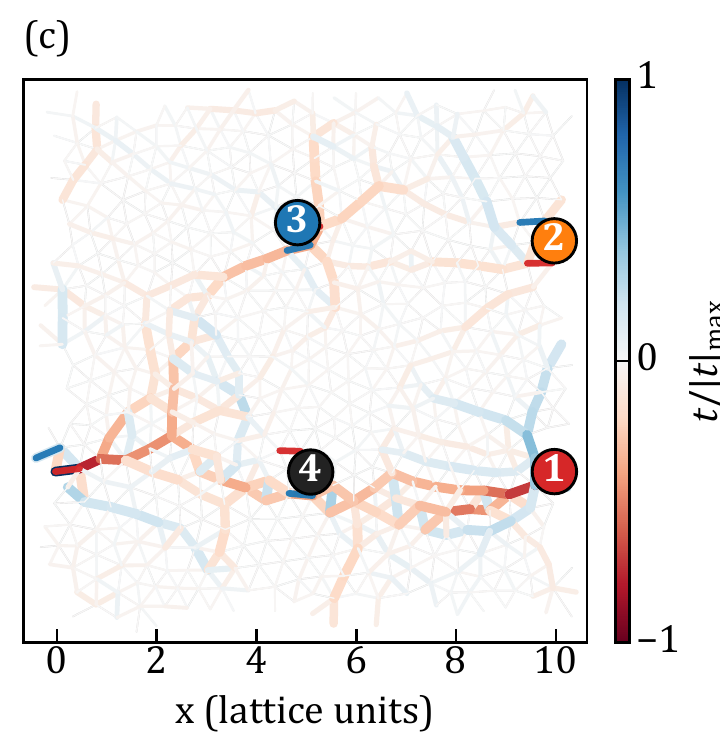
The physical pathway. Rather than dispersing impact stresses uniformly, training rearranges the wall’s crosslink stiffnesses into connected force chains, transmitting the localized contact load directly to a targeted far-side motor anchor.
Figure 4c · arXiv:2611.07112
Moving physical learning into an embodied agent reveals constraints that isolated networks ignore. For the cell wall to successfully steer the organism, static mechanical routing is not enough: the transmitted signal must be strong enough to switch the flagellar actuator before the collision ends. At physiological loads, the trained network delivers a signal that easily beats this 0.11-second contact window, while an untrained network completely fails to actuate in time.
Furthermore, this structural memory does not require a static substrate. In simulations with continuous enzymatic turnover of the wall, the learned mechanical routing survives, provided that the tension-bearing crosslinks are preferentially protected from severing.
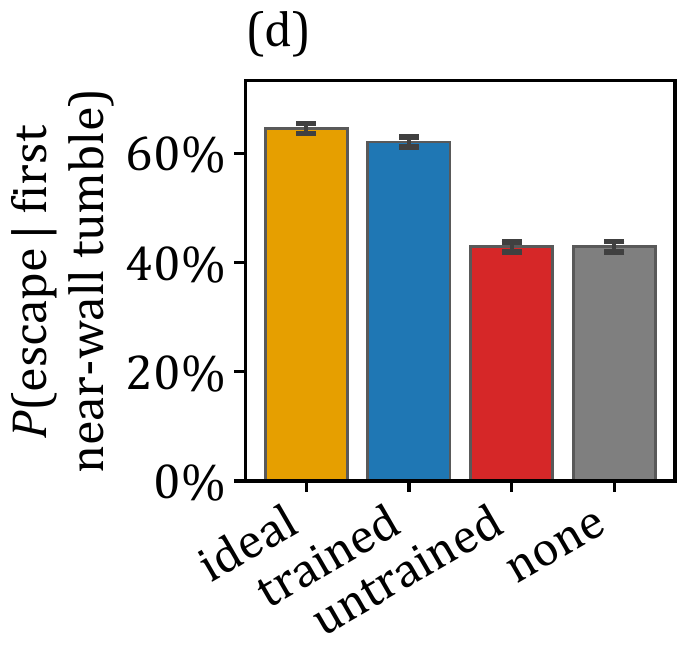
Behavior without a brain. On the first near-wall tumble, the trained wall escapes 62% of the time, against 43% for an untrained wall and 65% for an ideal controller. In the model, the structural material itself closes the sensorimotor loop.
Figure 6d · arXiv:2611.07112
Does learning create a need for sleep, even without biology?
Learning uses up a spring network’s capacity to learn. Repair brings that capacity back, and repair works better once the task is set aside.
We study a minimal physical learner: a spring network trained on a continual stream of tasks. Learning progressively reduces its ability to acquire new tasks. The pattern echoes the synaptic homeostasis hypothesis, which proposes that sleep restores a capacity for plasticity that waking experience has used up (Tononi & Cirelli 2006).
The mechanical analogue of that saturation sits in the bonds. Learning drives each bond’s share of the load toward a limit, and a bond near either limit has less influence on the response to a new task. A conserved topological budget links this polarization to the decline in learning capacity, one for one. The polarization acts as a mechanical analogue of sleep pressure, the need for sleep that builds up during wake (Borbély et al. 2016).
Local random perturbations let each bond estimate its own load share and guide a restorative change in stiffness. Guided repair restores learning capacity at a cost to memory, with a better balance of acquisition and retention than repair that relaxes bonds blindly toward their rest stiffness. During learning, task activity biases those measurements toward weakening the bonds in use. Moving the repair offline avoids the interference. Offline repair improves continual learning compared with learning alone, and compared with learning and repair running together.
That bias also separates the two directions of repair. Strengthening can proceed during wake, while weakening waits for sleep, in parallel with firing-rate homeostasis in rat visual cortex (Hengen et al. 2016; Torrado Pacheco et al. 2021). Withholding repair increases the repair required later, in parallel with compensatory sleep after deprivation (Borbély et al. 2016). Sleep-like offline phases are needed when learning reduces adaptability and ongoing task activity distorts the measurements used for restoration.
In these simulations an external supervisor schedules wake and repair and sets the recovery target. Whether that offline phase can arise on its own is the next project, Emergence of sleep–wake rhythms.
How do crypts form in an intestinal organoid?
Organoids are miniature intestines grown in the lab: a single intestinal stem cell can grow into one, complete with crypts, the pockets in the gut lining where stem cells live (Sato et al. 2009). I’m investigating crypt formation in intestinal organoids with M. Blatchley. We use S. Ameen’s model of a spheroid embedded in the extracellular matrix (ECM), built on T. Zhang’s three-dimensional vertex model code, to explore how the mechanics of cells and their surroundings contribute to the developing tissue’s shape.
What role do cell shape and mechanical interactions play as crypts form?
How does the extracellular matrix affect the organoid’s shape and the formation of crypts?
How do interactions between cells and matrix shape tissue architecture in three dimensions?
Can a daily rhythm arise by itself?
This project follows Sleep without biology, with N. Pashine and J. M. Schwarz. There, continual learning creates a need for an offline phase, and an external supervisor decides when that phase happens. The paper on that project, “Why continual physical learners need sleep,” is coming out soon.
Living systems regulate that switch for themselves. They operate out of equilibrium, harvesting and dissipating energy to sense errors (Lan et al. 2012), revise their own structure, and decide when to disengage from the environment.
The aim is to find the energetic conditions under which an offline phase emerges on its own, and to see how an internal demand for repair can couple to environmental energy cycles and produce a sleep–wake rhythm.
Full essays are gradually moving here.
Recent
Preprint · arXiv:2611.07112
With N. Chen and J. M. Schwarz. Read the paper
Poster · Boulder Summer School
Talk · APS March Meeting, Denver
Poster · MPI-PKS, Dresden
Older talks, teaching, and service are in my CV.
Photographs by Nada Elmeligy · @sedated_gaze
Select a photograph to view it in full.
About
My path began in theoretical high-energy physics at Zewail City in Egypt. I started my PhD at Syracuse in experimental quantum computing, and in 2024 I joined the Jennifer Schwarz theory group and turned to the physics of learning in living and non-living matter.
Two commitments shape my vision. The first is to study nature on its own terms, rather than through the categories we expect it to fit. The second is to make scientific ideas available across the economic, cultural, and linguistic divides that still decide who can read, contribute to, and benefit from science.
Outside the lab, I photograph, write, and occasionally paint.
Get in touch
nnelmeli@syr.eduIf you are curious about the work, want to collaborate, or are working to widen access to science, I would be glad to hear from you.
